Pirca gives a software house one sealed cloud cell per US client, where our coding model works on that client's code.
Assign a ticket and the model reads the client's repository, brings up its application, writes the change and runs the client's tests and a browser check. The evidence and a log of every input and output go on the pull request, which one of your own engineers on that client approves before the client sees it. A renewal that asks which AI touched the code and where it ran gets a short answer: our models and no one else's, N. Virginia, and a log the client can open.
Book a call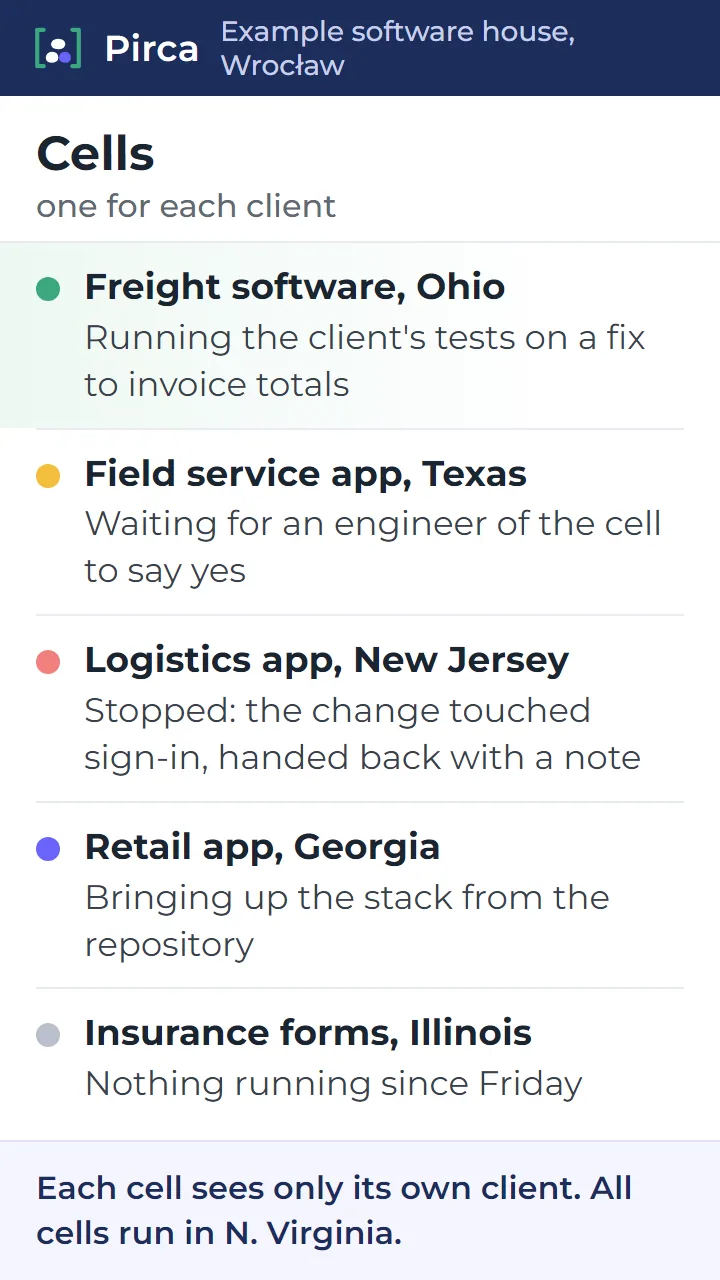
It takes two clients to need a wall between them.
Each client's cell runs our models, no one else's, and they see only that client's code.
The engineers could list their AI tools in an email to the client. The email costs nothing.
It even answers the clause's first line. For the rest, our model drafts a disclosure from the cell's log each month, and your head of delivery signs it.

- Tools usedOur coding model, its checker and the repository index
- Where it ranOne cell in N. Virginia, not a laptop
- Every input and outputLogged in full and hash-chained
- The logOpen to your client's reviewers, as California's courts ask
- Other AI toolsStopped until approved. A cell reaches none
- SubcontractorsThe rule flows down. This line is yours to fill
A client's code, keys, test data and log never reach another client's cell or an outside AI service.
The model never pushes to a client's branch or merges. It is also not the strongest model on the market, and no other agent can run in a cell.
produce audit trails, logs, or hashes that document the inputs and outputs in its Gen AI process
Washington State Department of Enterprise Services.Template generative AI clauses for IT procurement, April 2025.
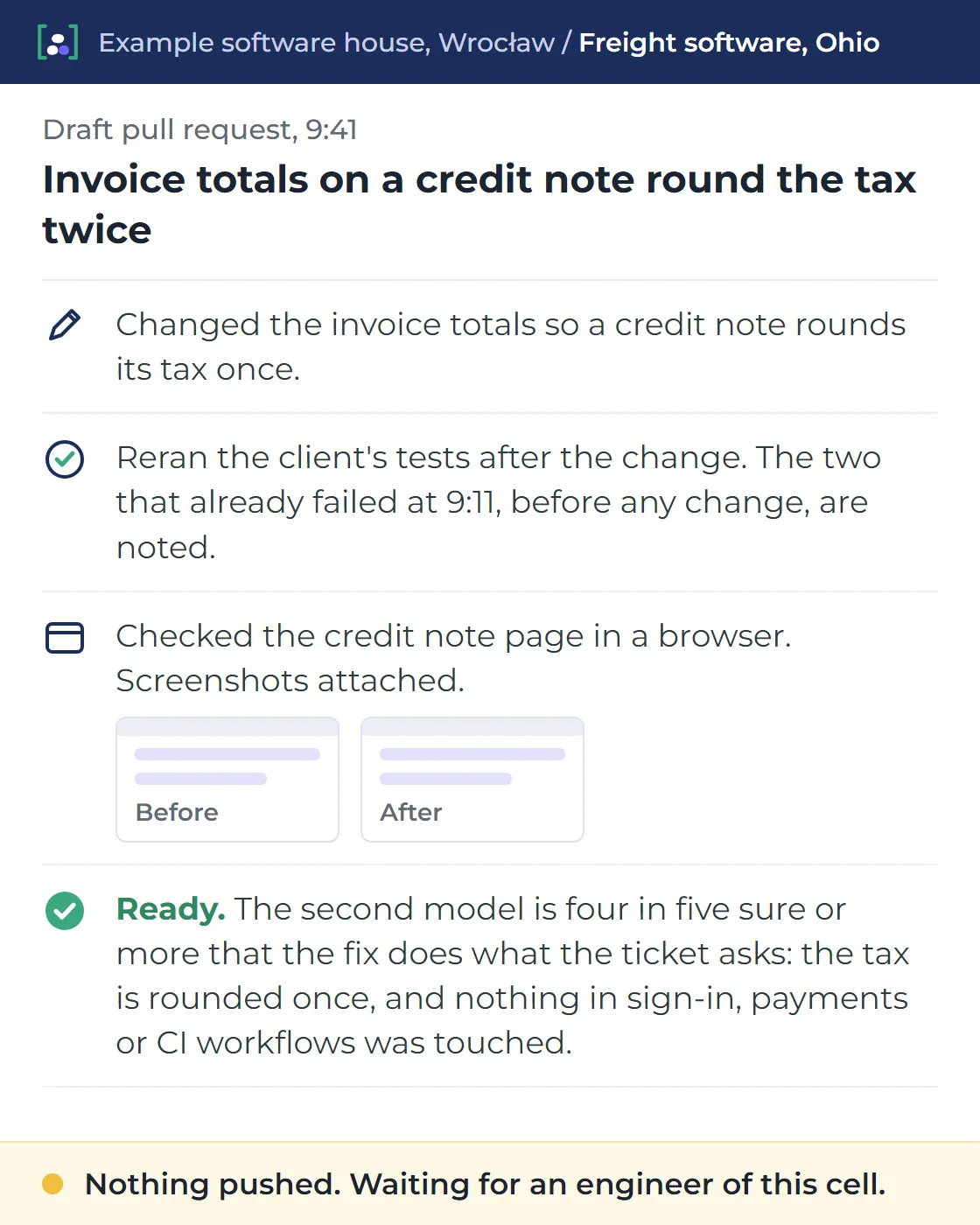
The fix is ready at 9:41. It leaves the cell at 10:15, when an engineer says yes.
An example ticket in the Freight software cell: invoice totals on a credit note round the tax twice. A change that touches sign-in, payments or CI workflows is stopped and handed back with a note.
9:04
The model reads the ticket, the Freight software repository and the notes the cell's engineers keep. The other four cells are out of its reach.
9:11
It starts the client's application and runs the client's own tests on untouched code. Two already fail; it notes both before changing a line.
9:38
It fixes the rounding, reruns the suite, checks the credit note page in a browser and clips the results to a draft pull request.
9:41
It stops and pushes nothing. A second model grades the fix: ready at four-in-five confidence or more, otherwise unsure, with reasons.
10:15
An engineer of the cell reads the fix, the screenshots and the log, says yes, and the pull request goes to the client's reviewers.

Times are Wrocław's. Ohio is six hours behind, and the pull request is waiting when the client's reviewers start their day.
Each cell runs its own copy of our models, on its own GPU in N. Virginia, and shares nothing with the cell next door.
Under the GDPR we are your processor: a cell's contents serve that cell only, are never passed on, and are deleted after it closes.
No staging or production data enters a cell, so a bug that shows only with real records cannot be reproduced there.
- ModelsDevstral Small, fine-tuned by us, writes the change; a checker grades it; an index model reads the code. Cell contents train no shared model.
- Contract endsThe log goes to the client, and the cell is deleted within 30 days
- If Pirca stops60 days' notice, then every cell exported and deleted

On the first call we read one client's AI clause with you.
Tell us how many US clients you serve and whether a contract now names AI, so we know which client to start with.
Call times come back by the next working day, from Marek Zieliński, with the client whose clause we start on. Together we go through the clause and one repository's setup. Nothing is sent to us before the call. If it fits, the client's GitHub administrator installs the cell's App, and our coding model starts the cell from that repository.
$900 per client cell per month, and the model's hours are not metered.
One GPU per cell is why the cell is the unit. It also makes a small client's cell expensive.
Included
- Three tickets at once from our coding model, on the cell's GPU
- The cell, started and kept running, with unlimited engineer and reviewer accounts
- The log, its exports, monthly disclosure drafts, the handover at closing
On your side
- Cells connect to GitHub only. Each client's administrator there creates the cell's App and picks its repositories; some security teams take weeks.
- Add to each cell only its client's engineers. Two clients, two sign-ins.
- Someone collects the client's test keys, the slowest part of the first week, and confirms what the model must not touch.
The first cell runs free for 30 days after its GitHub App is installed. No card.