About
Pirca gives a Polish software house one sealed cloud cell for each US client, where a coding model of our own does the engineers' tickets on that client's code. Each cell holds one client's repositories, keys and running application, and logs every model input and output, because those clients' renewals now ask which AI touched the code and where it ran.
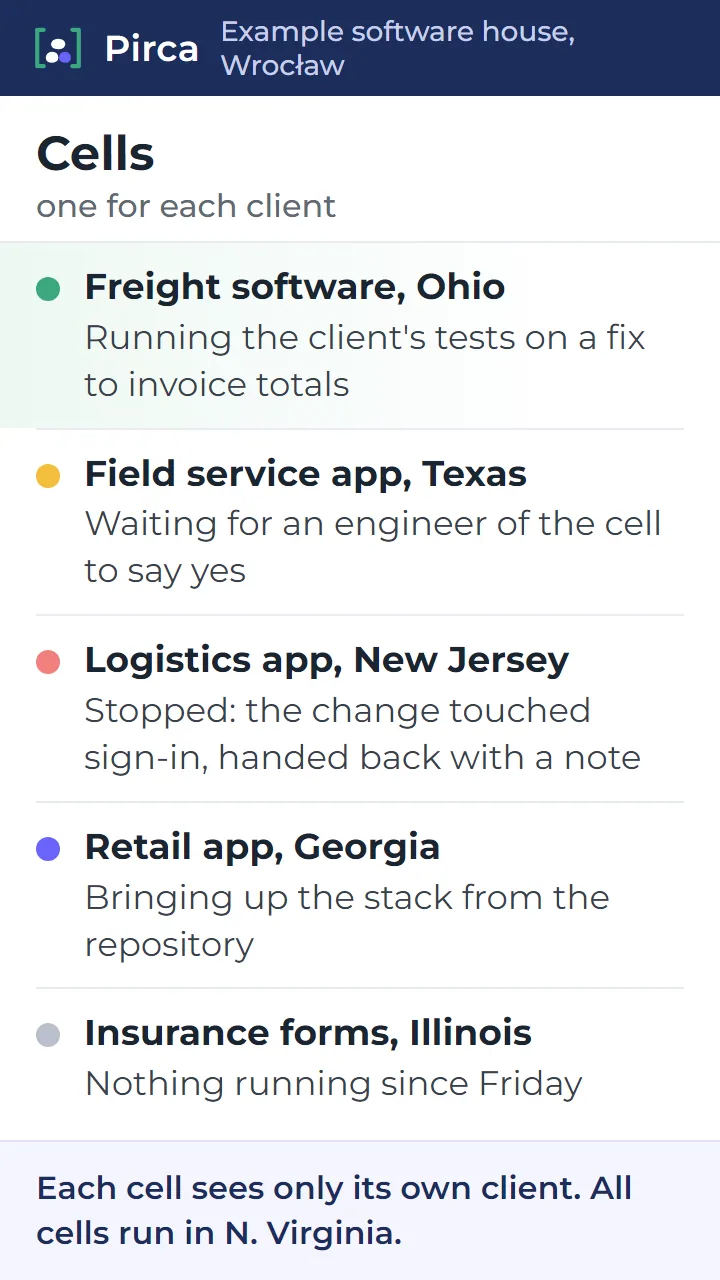
One sealed cloud cell per agency client, where our coding model works
Starting a stranger's application from its repository and writing the change a ticket asks for are the two jobs Pirca gives its coding model. Rules do neither well: a Compose file never says which variables a test needs or what seed data lets a user sign in. At start-up the model reads the README, Dockerfiles, CI workflows, migrations and fixtures; for a ticket, the files the cell's code embedding model finds closest and the engineers' notes.
On every ticket Pirca's coding model tests the untouched code, makes the change, then retests with a browser check; a small checker model grades the result. Below four in five confidence that a change does what its ticket asks, it reaches the engineer marked unsure, with reasons. Changes touching sign-in, payments or migrations that drop or rewrite data go back with a note, and two failed test runs end a try. Only an engineer's yes opens the pull request.
Pirca's coding model is Devstral Small, a 24-billion-parameter open-weight model from Mistral AI. We fine-tune it and the checker each quarter on cloud GPU capacity we control in N. Virginia, using permissively licensed public tickets and our own practice repositories, where each attempt with our reviewer's yes or no becomes a preference pair we own. Nothing from a client's cell enters that corpus.
Weekday mornings and each new client's first week decide when Pirca needs its GPUs. Every agency's tickets arrive in the same few hours, and a new cell indexes a whole repository and runs its tests three times. One 48 GB GPU per cell serves its three models, with room for three tickets at once, and is released after twenty idle minutes.
Pirca keeps every cell and its models on cloud capacity we control in N. Virginia, because US clients' contracts ask where their code ran and bar undisclosed AI. From February 2027 the cells' weekday GPU hours come under a one-year reservation; from May 2027, with a client's written consent, its cell's model can be tuned on its merged pull requests, on that cell's GPU.
Pirca was registered in Wrocław in November 2024 to give software houses one cloud workspace per client. Those workspaces could not show what a coding agent did, so in 2025 we began fine-tuning our own model; cells with it entered a closed beta in June 2026.
On the first call we read one client's AI clause with you.
Book a callLeadership
Bartosz Kmieć
Founder
Ran delivery for eight years at a Wrocław software house with US clients, keeping one SSH key and git identity per client on his laptop and answering every client's security questionnaire by hand.
Agnieszka Rutkowska
CISO
Approved contractors' access to code for seven years on a Warsaw bank's security team, one repository, one key and one log per vendor, and drew the wall every Pirca cell is built on.
Marek Zieliński
COO
Staffed and billed client cells at a Kraków software house for six years, from timesheets to renewals, and now runs each customer's first week with Pirca and the contracts behind every cell.
Registered in Wrocław, November 2024
$900 per client cell per month, and the model's hours are not metered.
See the price